
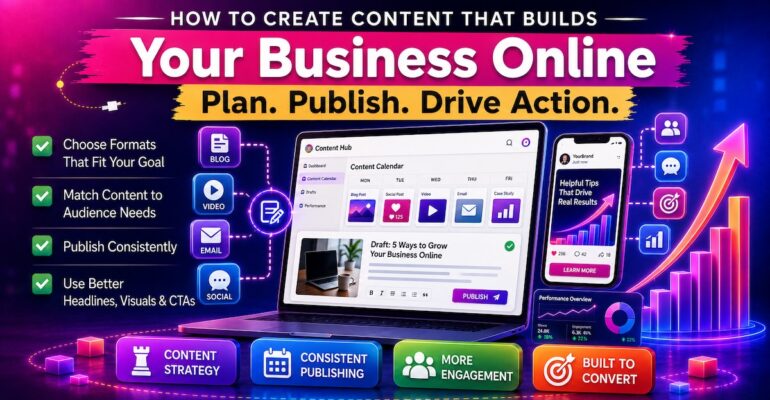
For small business owners trying to grow online, content often turns into a pile of posts that take time but don’t earn attention or sales. The challenge is rarely effort; it’s the lack of a clear digital marketing strategy, a consistent brand identity, and purposeful online customer engagement that guides what gets published and why. When those pieces are missing, content feels like busywork and the content marketing importance is easy to question. With the right foundation, every piece of content can strengthen visibility, build trust, and prompt action.
Key Takeaways at a Glance
- Choose engaging content formats that make your message easier to consume and act on.
- Use quick audience needs analysis to create content that solves real problems.
- Follow a content publishing schedule to stay consistent and reinforce your brand.
- Improve visuals and headlines to increase attention, clarity, and click-through.
- Track performance measurement metrics to learn what works and keep improving.
Storyboard Before You Publish: Plan Flow, Visuals, and CTAs
Once you know the moves that drive action, the next win is making sure every piece of visual content flows in a way people can follow. Creating a storyboard helps businesses plan the sequence, visuals, messaging, and calls to action for videos or visual campaigns so the final content feels clear, cohesive, and aligned with the brand. Instead of building scenes and assets on the fly, you map what happens first, what the audience sees, what you say in each moment, and where the CTA fits, before production starts. An AI storyboard generator can speed this up by turning rough ideas into an organized storyboard sequence that visualizes scenes, narrative flow, and creative concepts so you can spot gaps and ensure consistency early. If you want a concrete example of how this looks in practice, explore Adobe Firefly storyboard AI as a way to visualize and organize your campaign’s story beats before you spend time creating.
Build a Simple Content Engine That Drives Action
Content works best when you treat it like a repeatable system, not a one-off post. This quick process helps you choose the right formats, speak to the right people, publish consistently, and upgrade the details that make readers click and act.
- Choose one format that matches your goal
Start with the action you want, such as booking a call, getting an email signup, or selling a product. Then pick the simplest format that supports that action: a how-to blog for search, a short video for awareness, or a checklist for capturing leads. Limit yourself to one primary format for the next 2 to 4 weeks so you can build momentum. - Segment your audience into 2 to 3 groups
Write down 2 to 3 clear audience slices, such as “new to the problem,” “comparing options,” and “ready to buy.” Use what you already know about your target audience to list their top questions, common objections, and the words they use when they search. This keeps your message specific, so your content feels like it was made for them. - Map topics to each segment and add one CTA
For each audience group, choose 3 to 5 topic ideas that solve a single problem and lead naturally to one next step. Add one clear call to action per piece, such as “download,” “reply,” or “book,” and make sure it matches the reader’s stage. If you are using visuals, sketch a simple flow so the message and the CTA appear at the right moment. - Set an editorial calendar you can actually keep
Pick a realistic publishing cadence, such as one post per week or two short videos per week, and lock in days you will create, review, and publish. Make it easier to follow by setting deadlines for each step, not just a final publish date. Consistency beats intensity because it trains your audience to expect you. - Upgrade execution with headlines and visuals
Write 5 to 10 headline options before you choose one, focusing on a clear benefit, a specific audience, or a strong outcome. Then tighten your visuals by improving readability and focus: one main idea per graphic, high contrast text, and a single focal point per scene. These small upgrades often make the difference between being skimmed and getting a click.
Plan → Publish → Repurpose → Measure → Improve
This rhythm turns content into a loop you can repeat without guessing. You create one strong asset, distribute it across the channels your audience already uses, then use performance signals to refine the next round. Over time, this builds a clear path from attention to action.
| Stage | Action | Goal |
| Plan the anchor | Pick one topic, audience slice, and one conversion action | Clear intent and a focused message |
| Create and publish | Produce the anchor piece and add one simple CTA | A complete asset that drives one step |
| Repurpose for reach | Break into clips, quotes, emails, and posts | Multi-platform distribution without extra ideation |
| Engage and capture | Reply, ask one question, route clicks to a form | Stronger audience engagement metrics |
| Measure and adjust | Review saves, clicks, replies; note drop-off points | Performance analytics that guide changes |
| Iterate the next cycle | Update the outline, hook, CTA, or format choice | Continuous content optimization that compounds |
Each phase feeds the next: planning reduces rework, repurposing protects your time, and measurement removes opinion from decisions. The goal is not perfection, but consistent learning that makes every future post easier to produce and more likely to convert.
Stay Consistent and Grow a Digital Presence That Converts
Most businesses don’t struggle with ideas, they struggle to publish consistently without diluting the message. The approach is simple: treat content as long-term content planning, built on repeatable workflows and strategic content creation benefits that compound over time. Do that, and digital presence growth becomes steadier, brand consistency advantages get stronger, and the audience interaction increase shows up in replies, clicks, and returning visitors. Consistency beats intensity when content is tied to a clear business goal.wth-driven website strategies are applied, the website implementation benefits show up as cleaner handoffs, stronger follow-up, and business scalability through websites that can handle more demand without more chaos. A website should earn its keep by turning attention into action. Choose one upgrade this week, connect the system that matters most or fix the performance bottleneck, and put it live. That steady rhythm is what makes digital transformation for SMBs durable, predictable, and growth-ready.
Unlock your business’s potential with NavaWeb, your go-to partner for Web Design Services in Vancouver, BC, Branding & Logo Design Services in Vancouver, BC, and powerful digital marketing strategies!